
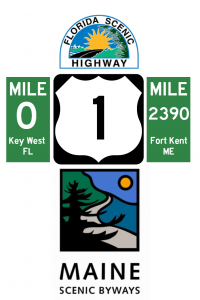
US Route 1 is the longest North South highway in the United States, running from Florida to Maine. In Florida, it goes all the way to the Southernmost Point in Key West. In Maine, it goes all the way to the Canadian border in Fort Kent. It generally parallels I-95, however the interstate does not go to the Florida Keys or to northern Maine. US Route 1 traces the original Atlantic Highway
In This Post
US Route 1: By The Numbers
- 2,390 Miles Long
- 14 States (Plus the District of Columbia)
- 62-90+ Hour Travel Time
- 6 National Parks Nearby
- 2 Extreme Points (Southernmost and Easternmost)
- Built in 1926
US Route 1: The Route
US Route 1 begins (or ends) in beautiful Key West Florida. It is actually the only road in and out of the Southernmost City. From Key West to Florida City, US Route 1 is also called the Overseas Highway. This first stretch is 113 miles long and is comprised of 42 bridges linking 44 different islands. Without stops, it takes about 3 hours to reach the mainland from Key West, but there are many worthwhile stops along this route.
Once it reaches the mainland of Florida, US Route 1 goes through Miami and up the Florida coast through Jupiter, St. Augustine, and Jacksonville. Along this portion there are two National Parks, as well as a number of National Monuments and State Parks. All told, without stops it can take 18 hours or more to cross the state of Florida on US Route 1.
From Florida, US Route 1 crosses into Georgia where it passes near the Okefenokee National Wildlife Refuge, through the town of Santa Claus, and up to Augusta. Here it crosses into South Carolina, where it goes through Columbia and on into North Carolina, traveling through Raleigh/Cary.
After the Carolinas, US Route 1 goes through Virginia, cutting through Richmond and Alexandria before going through the heart of our nation’s capitol, Washington D.C. From D.C., it goes through Baltimore and briefly across Pennsylvania and New Jersey before crossing into New York City in the Bronx.
Once in the New England states, US Route 1 mostly stays near the Atlantic Coast, traveling through Connecticut, Rhode Island, Massachusetts, New Hampshire, and finally Maine. In Maine, it follows the Eastern edge, passing near the Easternmost point of Quoddy Head, and then continues along the US/Canadian border until reaching it’s terminus in Fort Kent, Maine.
US Route 1: Things to Do
One of the best things about great American road trips is all the road side attractions and stops you can make along the way. With a road trip, the journey really is much more important than the destination, and US Route 1 definitely does not disappoint.
Florida
- Fort Zachary Taylor State Park
- Dry Tortugas National Park
- Southernmost Point in the Contiguous US
- Bahia Honda State Park
- John Pennekamp Coral Reef State Park
- Canaveral National Seashore
- Everglades National Park
- Biscayne National Park
- Jupiter Inlet Lighthouse
- Blowing Rocks Preserve
- St. Augustine Lighthouse
- Castillo de San Marcos National Monument
Georgia and the Carolinas
- Okefenokee National Wildlife Refuge
- Chesser Island
- Congaree National Park
- Juniper Level Botanic Garden
- Santa Claus
- Okefenokee Swamp Park
- Hemlock Bluffs Nature Preserve
- Raleigh Municipal Rose Garden
Mid-Atlantic States
- Shenandoah Valley National Park
- Occoquan Bay National Wildlife Refuge
- B&O Railroad Museum
- New York Botanical Garden
- Washington D.C. National Mall (Monuments and Museums)
- National Aquarium Baltimore
- Longwood Gardens
- Bronx Zoo
New England States
- PEZ Visitor Center
- The House of the Seven Gables
- Salem Heritage Trail
- Life Size Chocolate Moose at Len Libby Candies
- Lobster Boat Tours
- Acadia National Park
- West Quoddy Head – Easternmost Point in the Continental US
- Gillette Castle State Park
- Derby Wharf Light Station
- Salem Witch Trials Memorial
- USS Albacore Museum
- Swinging Bridge Park
- Fort Knox and Penobscot Narrows Observatory
- 45th Parallel North Marker
- America’s First Mile
National Parks Along US Route 1
There are 6 National Parks that are either right along US Route 1 or fairly close, and three of them are all in Southern Florida. First is Dry Tortugas National Park, home of Fort Jefferson. This island is 70 miles west of Key West and is only reachable by boat or seaplane. As such, visiting Dry Tortugas pretty much needs an entire day, but it is definitely worth it. Whether you are a history buff interested in the Fort, or an avid snorkeler looking for some of the best waters in the Florida Keys, the Dry Tortugas are a day well spent.
Just across the last bridge of the Overseas Highway there are two more National Parks. The Everglades is a world famous National Park full of wildlife. Take a couple hours and go for a hike, or book an air boat tour to see gators and other wildlife. Right on the other side of US Route 1 is Biscayne National Park. This National Park is mostly in the water, but even if you don’t want to take a boat out there are options. The Jetty Trail and visitor center can be done in under an hour, and would make a great addition to any road trip.
Next there is Congaree National Park in South Carolina. With over 26 thousand acres of land, Congaree preserves the largest tract of hardwood forest in the United States. Available hiking trails range from strenuous, full day hikes to a relaxing stroll along the boardwalk. Congaree also has a number of canoe trails if you want to get out on the water for a day.
In Virginia, Shenandoah National Park is a great day trip. It is about an hour and a half off of US Route 1, but if you have the time it’s worth a visit. Best (and busiest) in the fall, Shenandoah has hundreds of available hikes. If you would rather stay in the car, you can also drive the entire park along the Skyline Drive.
Finally in Maine there is Acadia National Park. Acadia has it all; woodlands, mountains, and coastal trails. Covering 47,000 acres, Acadia is full of camping, hiking, and other recreation options.